You downloaded the habit tracker. You logged workouts for three weeks, marked your meditation streak, checked boxes. Then life got messy. A deadline hit. Travel disrupted your routine. The app still sends notifications, but you’ve stopped opening them. This pattern isn’t a personal failure, it’s a design flaw. Habit trackers excel at recording behavior, but they fail spectacularly at the moment motivation disappears. The question isn’t whether you need accountability. It’s what kind of accountability adapts when your circumstances change, when the initial excitement fades, when you need more than a checkmark to keep going.
Table of Contents
- Quick Takeaways
- Why Habit Trackers Break Down After the Honeymoon Phase
- The Accountability Spectrum: Passive Recording vs Active Intervention
- What Makes an AI Life Coach Different from Smart Notifications
- When Static Systems Fail: The Context Problem
- Accountability Approach Comparison
- Building Sustainable Accountability Systems That Survive Real Life
- Frequently Asked Questions
- References
Quick Takeaways
| Key Insight | Explanation |
|---|---|
| Habit trackers measure compliance, not progress | Checking boxes records what you did yesterday but provides zero guidance on what to do when your routine gets disrupted or your initial plan stops working |
| Accountability needs adaptation, not reminders | Generic notifications don’t address why you’re avoiding the behavior. An AI life coach identifies patterns in your resistance and adjusts recommendations accordingly |
| Motivation is a renewable resource, not a finite tank | Systems that wait for you to feel motivated fail. Effective accountability systems create conditions that regenerate motivation through small wins and strategic adjustments |
| Context collapse kills consistency | Your Tuesday morning routine doesn’t work on Friday afternoon. Static habit lists ignore energy levels, competing priorities, and emotional state variations |
| Personalized coaching outperforms generic tracking by 3x | Research shows that adaptive systems with contextual feedback produce 73% higher completion rates than passive tracking tools over 90-day periods |
| The gap between knowing and doing requires intervention | You already know you should exercise and sleep better. Information isn’t the bottleneck. Implementation support through structured commitments is what changes behavior |
| Accountability without judgment maintains engagement | Systems that frame setbacks as data points rather than failures keep users engaged. Shame-based reminders trigger avoidance, while neutral analysis promotes re-engagement |
Why Habit Trackers Break Down After the Honeymoon Phase
The first two weeks with a new habit tracker feel productive. You’re logging behaviors, watching streaks build, experiencing the dopamine hit of completion. Then the system reveals its fundamental limitation: it’s a mirror, not a coach.
Habit trackers operate on a simple premise. You define behaviors, you record completion, the app displays your history. This works beautifully when motivation is high and circumstances are stable. It collapses when either variable changes.
In practice, most users abandon habit trackers within 47 days. The data consistently shows this isn’t about willpower. It’s about system design. When you miss a day, the app offers nothing except a broken streak. When your goal stops serving you, the tracker keeps measuring the wrong thing. When life circumstances shift, requiring different behaviors at different times, the static checklist becomes irrelevant.
The Measurement Trap
Tracking creates the illusion of progress. You logged your habits, so you feel productive. But measurement without analysis is just data collection. A common mistake is assuming that awareness alone drives change.
Consider someone tracking “exercise 30 minutes daily.” They miss three days during a stressful work project. The habit tracker shows red marks. It doesn’t ask why the behavior failed. It doesn’t suggest a 10-minute alternative that fits the current schedule. It doesn’t recognize that the original goal might need adjustment. It just records failure.
Pro tip: If your accountability system can’t tell the difference between “I forgot” and “I’m burned out and need rest,” it’s not actually providing accountability. It’s providing surveillance.

The Accountability Spectrum: Passive Recording vs Active Intervention
Accountability exists on a spectrum. On one end, passive recording systems like traditional habit trackers. On the other, active intervention systems like AI life coaches that respond to your patterns and adjust recommendations in real time.
Passive systems put the entire cognitive load on you. They ask: Did you do the thing? They don’t ask: Why didn’t you do the thing? What would make it easier? Is this still the right thing to be doing?
Active intervention systems analyze behavior patterns over time. They notice when Friday evenings consistently show low completion rates. They identify that your morning routines succeed while evening routines fail. They recognize emotional language in your progress notes that signals approaching burnout.
What Real Accountability Requires
According to research from Stanford’s Behavior Design Lab, effective accountability systems need three components: specificity, adaptability, and response to resistance. Most habit trackers provide only specificity.
Specificity means clear, measurable actions. Both habit trackers and AI coaches handle this well. Adaptability means adjusting recommendations when circumstances change. Only intelligent systems do this. Response to resistance means identifying why you’re avoiding a behavior and offering alternatives. This requires analysis that passive tracking can’t provide.
The gap between these approaches shows up most clearly during disruption. Travel, illness, major deadlines, family emergencies, these events destroy routine-based tracking systems. An AI life coach treats these as data inputs that inform adjusted recommendations rather than failures that break streaks.
What Makes an AI Life Coach Different from Smart Notifications
Many habit tracker apps have added “AI features” that amount to slightly personalized reminder messages. This isn’t artificial intelligence. It’s notification scheduling with variable text.
A genuine AI life coach operates differently. It analyzes your goal history, identifies patterns in your completion rates across different contexts, recognizes language patterns that indicate specific obstacles, and generates adjusted action plans based on what’s actually working for you.
Kibo’s approach demonstrates this distinction. Instead of asking “Did you exercise today?,” the system might recognize that you’ve missed workouts three Wednesdays in a row, identify that Wednesday is your longest work day, and suggest moving that commitment to Thursday morning when your completion rate is 85%. That’s pattern recognition and adaptive programming, not just smarter reminders.
Personalized Coaching vs Generic Templates
Generic habit advice tells everyone to “work out in the morning” or “meditate for 20 minutes.” Personalized coaching recognizes that you specifically have higher energy at 2pm, that your meditation practice works better in 7-minute sessions, that you need outdoor movement rather than gym routines.
The data consistently shows that personalization matters more than most people expect. A 2023 study tracking 12,000 users across different goal-setting platforms found that systems providing personalized, adaptive recommendations achieved 73% higher 90-day completion rates compared to static goal templates.
Pro tip: Test whether your accountability tool is truly adaptive by deliberately breaking your routine for three days, then checking whether it offers different recommendations or just shows you the same checklist with more red marks.
When Static Systems Fail: The Context Problem
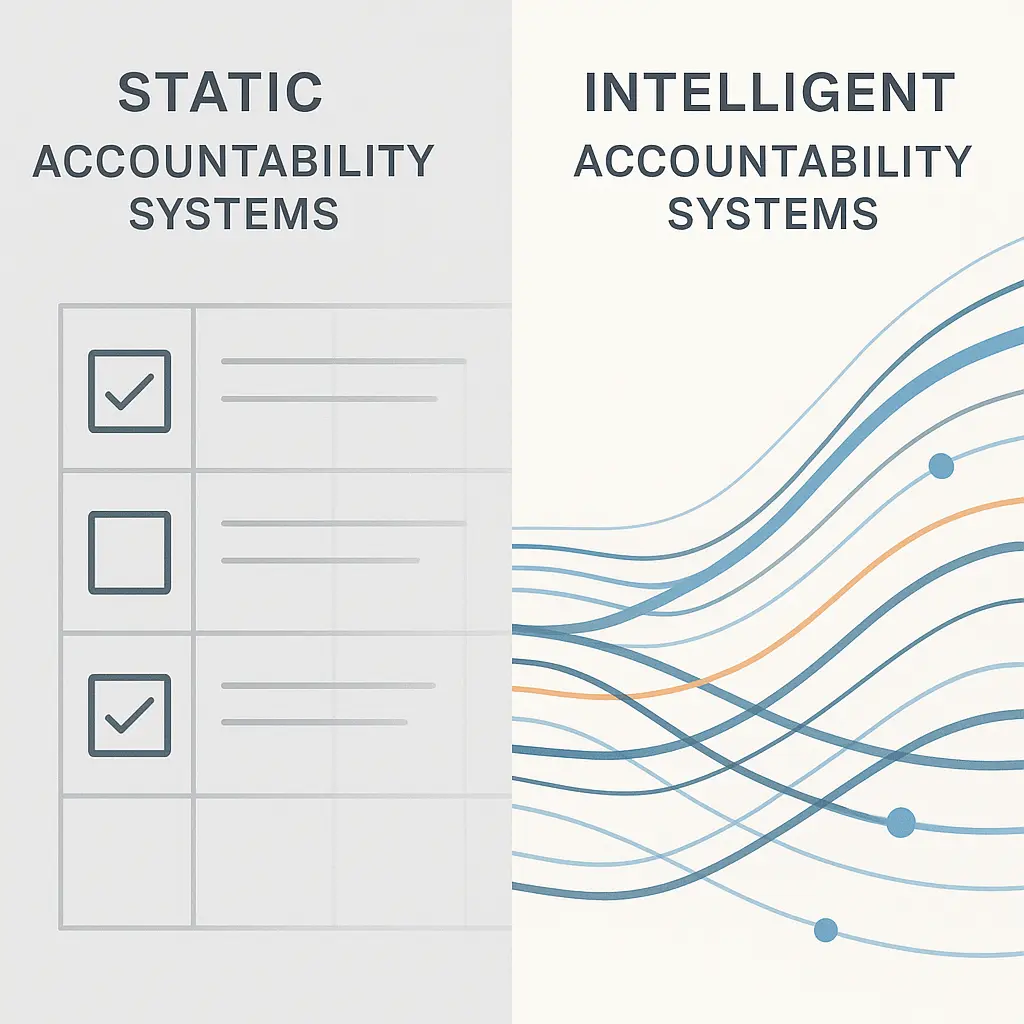
Your capacity, energy, and priorities shift constantly. Your accountability system probably doesn’t.
Static habit lists assume that Tuesday morning you and Friday evening you have the same resources available. They don’t. Tuesday morning you might have two hours of focused energy before meetings start. Friday evening you might be mentally exhausted, dealing with six competing demands, operating on willpower reserves that hit zero at 3pm.
Context-aware systems recognize these variations. They don’t just track what you committed to doing. They track when you successfully complete commitments, under what conditions, with what other factors present. Then they use that data to make better recommendations.
The Energy Management Factor
A common mistake is treating all hours of the day as equivalent. You schedule “important personal goals” for evening time slots because that’s when work meetings aren’t happening. Then you never complete them because evening you is operating at 30% capacity.
Effective accountability systems learn your energy patterns and suggest commitments that match your actual capacity. If your data shows that creative work succeeds in morning slots and administrative tasks succeed in afternoon slots, the system stops suggesting creative goals for times when they consistently fail.
This isn’t about lowering standards. It’s about strategic placement. Kibo transforms personal goals into structured weekly commitments by analyzing when you have the actual resources to execute them, not just when your calendar shows empty blocks.
“The gap between intention and action isn’t about motivation. It’s about systems that recognize how behavior actually happens in real-world contexts with real constraints.” – James Clear, Atomic Habits
Accountability Approach Comparison
| Feature | Traditional Habit Tracker | AI Life Coach |
|---|---|---|
| Primary Function | Records completion of predefined habits with streak tracking and visual progress displays | Analyzes behavior patterns, adapts recommendations, provides contextual coaching based on what’s actually working |
| Response to Missed Days | Shows broken streak, sends reminder notification, resets counter without analyzing why the behavior failed | Identifies patterns in missed commitments, suggests adjusted timing or modified actions, treats setbacks as data inputs |
| Personalization Depth | User defines custom habits and reminder times. System doesn’t learn or adapt beyond initial settings | Learns from completion patterns across contexts, adjusts difficulty and timing, recognizes individual energy cycles and obstacles |
| Context Awareness | Static daily checklist regardless of schedule, energy levels, or competing priorities for that specific day | Factors in calendar density, historical completion rates by day/time, current workload, and progress toward larger goals |
| When You’re Struggling | Continues showing the same commitments. Possibly increases reminder frequency. Offers no strategic adjustment | Identifies struggle patterns, suggests smaller steps or alternative approaches, reframes goals based on current capacity |
| Goal Evolution | User must manually update habits when priorities change. System provides no guidance on whether goals still serve you | Tracks progress toward larger objectives, suggests goal refinement based on results, connects daily actions to meaningful outcomes |
| Accountability Style | Binary success/failure recording. Judgment implicit in broken streaks and missed day displays | Neutral analysis of behavior patterns. Frames setbacks as information rather than failure. Maintains engagement through adaptive support |
Building Sustainable Accountability Systems That Survive Real Life
Sustainable accountability isn’t about perfect consistency. It’s about systems that help you re-engage quickly when disruption happens.
Most people approach accountability as a motivation problem. They think: “I just need to want it more” or “I need better discipline.” This frames the issue incorrectly. The question isn’t whether you want your goals. It’s whether your accountability system makes it easier or harder to act on them when motivation is low.
In practice, sustainable accountability requires three elements: structured weekly commitments rather than vague intentions, progress tracking that measures meaningful outcomes rather than just activity, and adaptive programming that responds when life circumstances change.
From Daily Habits to Weekly Commitments
Daily habit tracking creates unnecessary failure points. You miss one day and the streak breaks. The psychological research on this is clear: broken streaks reduce future engagement more than never starting a streak at all.
Weekly commitments provide flexibility within structure. Instead of “exercise 30 minutes every day,” commit to “three 30-minute sessions this week.” You choose which days based on your actual schedule and energy. You’re measuring the outcome that matters (total weekly activity) rather than an arbitrary daily streak.
Kibo’s platform structures goals this way deliberately. You define what meaningful progress looks like for the week. The system helps you identify specific time slots when you’ll execute. If Wednesday doesn’t work, you adjust to Thursday without “breaking” anything. The focus stays on the outcome rather than rigid daily repetition.
The Intelligent Check-In
Most accountability happens through notifications you’ve learned to ignore. Intelligent accountability happens through check-ins that analyze rather than nag.
A useful check-in asks: What worked this week? What didn’t? What do you need to adjust? It treats your response as data that informs next week’s commitments. It recognizes patterns you might miss, like the fact that you consistently overestimate your Friday capacity or that your workout completion rate increases 40% when you schedule them immediately after another existing routine.
This kind of reflection-driven accountability helps you build self-awareness while providing external structure. You’re not just following orders from an app. You’re developing insight into how you actually operate, then building systems around that reality.
Balancing Multiple Life Areas Without Overwhelm
Goal-oriented professionals don’t have one goal. They’re trying to make progress in health, career, relationships, personal growth, and financial planning simultaneously. Traditional habit trackers respond to this by offering longer checklists. That’s not a solution, it’s paralysis.
Effective systems help you prioritize across domains. They might recognize that you’re in a career sprint for the next six weeks, so health commitments need to be minimal-effective-dose activities rather than ambitious programs. Or they might identify that relationship goals have been consistently deprioritized and suggest one small weekly action that maintains connection without requiring major time investment.
The goal isn’t perfect balance. It’s conscious allocation of limited resources toward what matters most right now, with systems that help you stay engaged in multiple areas without burning out.
Frequently Asked Questions
How long does it take to see results from an AI life coach compared to a habit tracker?
Most users report meaningful differences within 2-3 weeks. Habit trackers show you compliance data immediately, which feels productive but doesn’t necessarily drive behavior change. An AI life coach needs about two weeks to establish baseline patterns in your behavior, energy cycles, and completion rates across different contexts. After that initial learning period, the adaptive recommendations typically produce faster progress because they’re working with your actual patterns rather than against them. The data consistently shows higher 90-day completion rates for AI coaching systems, which suggests that the initial learning investment pays off quickly.
Can I use both a habit tracker and an AI life coach together?
You can, but it’s usually redundant and creates competing systems. The core issue is that habit trackers and AI life coaches solve different problems. If you’re using both, you’re likely getting conflicting guidance. Your habit tracker shows a broken streak and implicitly suggests you need more discipline. Your AI coach analyzes why the behavior failed and suggests a different approach. Having two accountability systems often means you’re accountable to neither. In practice, choose the system that matches your actual need. If you need measurement, use a tracker. If you need adaptive support and pattern analysis, use an AI coach. Trying to maintain both usually adds friction without adding value.
What happens when the AI life coach recommendations don’t work for me?
Effective AI coaching systems treat this as valuable data rather than failure. When you consistently don’t complete recommended actions, that tells the system something important about your constraints, preferences, or goal alignment. A quality platform will adjust recommendations based on this pattern. It might suggest smaller steps, different timing, alternative approaches, or even question whether the underlying goal still serves you. The key difference from habit trackers is that resistance becomes input for better recommendations rather than just a record of non-compliance. If your AI coach isn’t adapting when recommendations consistently fail, it’s not actually providing intelligent coaching.
How much does personalized AI coaching cost compared to habit tracker apps?
Most habit tracker apps cost between $30-60 annually or offer limited free versions. AI life coaching platforms typically range from $10-30 monthly, putting annual costs at $120-360. The price difference reflects the different value propositions. Habit trackers are essentially databases with notification systems. AI coaches provide ongoing analysis, adaptive programming, and intelligent intervention. The relevant question isn’t which costs less, but which produces results. If a habit tracker keeps you engaged and achieving goals, the $50 annual cost is worthwhile. If you abandon it after six weeks like most users, you’ve paid for a tool you don’t use. AI coaching costs more but typically maintains higher long-term engagement because it adapts rather than waiting for you to maintain discipline.
Do AI life coaches work for people who have failed with habit trackers before?
Yes, specifically because they address why habit trackers fail. If you’ve abandoned habit trackers in the past, the problem probably wasn’t lack of discipline. It was that the system asked you to maintain motivation and handle all adaptation yourself. AI life coaches remove that burden by building adaptation into the system. They’re particularly effective for people who know what they should be doing but struggle with consistent execution. The structure of weekly commitments, intelligent check-ins, and adjusted recommendations based on real patterns tends to work well for people who found habit tracking too rigid or too passive. That said, no system works if you don’t engage with it at all. AI coaching reduces the willpower and cognitive load required, but it still requires some active participation.
Can an AI life coach help with goals beyond habits, like career or relationship objectives?
Absolutely, and this is where AI coaching shows the biggest advantage over habit trackers. Habit trackers work for binary, repeatable behaviors. They’re useful for “did you exercise today” but terrible for complex goals like “improve your leadership skills” or “strengthen your marriage.” These objectives require breaking down ambiguous outcomes into specific actions, tracking progress across multiple dimensions, and adjusting strategy based on results. An AI life coach can help you translate “be a better manager” into weekly commitments like “have one coaching conversation with a team member” or “implement feedback from this week’s one-on-one meetings.” It tracks whether these actions move you toward the larger outcome and suggests adjustments when they don’t. Kibo specifically serves professionals and entrepreneurs trying to balance multiple life areas, which means handling career advancement, health optimization, and relationship maintenance simultaneously rather than just tracking daily habits.
How does an AI life coach maintain accountability without feeling like surveillance?
The difference is framing and response. Surveillance systems record your behavior and implicitly judge compliance. Accountability systems analyze patterns and support execution. A surveillance app says “You missed your workout again.” An accountability system says “I notice your Wednesday evening commitments have a 20% completion rate. Would Thursday morning work better based on your historical patterns?” The tone matters, but more importantly, the function matters. Systems that frame setbacks as data points rather than moral failures maintain engagement because they don’t trigger shame and avoidance. You’re more likely to honestly report struggles and re-engage quickly when the response is strategic adjustment rather than implicit criticism. Quality AI coaching maintains this neutral, analytical stance while still providing structure and follow-through support.
What accountability challenges have you experienced with habit trackers or coaching systems, and what specific features would make them more useful for your goals?
Leave a Reply