You’ve tried three different habit trackers this year. You log your daily tasks religiously for two weeks, then the checkmarks slow down, and by week four, you’ve stopped opening the app entirely. The problem isn’t your willpower. Traditional habit trackers measure consistency, not progress toward meaningful outcomes. If your goals involve complex behavioral changes like building a business, transforming your health, or deepening relationships, checking a box doesn’t address the real obstacles holding you back.
Table of Contents
- Quick Takeaways
- Your Goals Require Adaptive Strategy, Not Repetition
- You Need Context-Specific Feedback, Not Binary Completion
- Motivation Fades Without Meaningful Progress Tracking
- You Juggle Multiple Life Areas Simultaneously
- Accountability Feels Shallow When Automated
- Your Obstacles Are Psychological, Not Logistical
- Generic Habits Don’t Map to Personalized Outcomes
- What Goal-Oriented Professionals Use Instead
- Frequently Asked Questions
- References
Quick Takeaways
| Key Insight | Explanation |
|---|---|
| Complex goals need adaptive programming | Habit trackers assume static routines work, but career growth and relationship development require strategy adjustments based on real-time feedback. |
| Binary completion misses nuance | Checking a box doesn’t capture quality, intensity, or contextual factors that determine whether an action drives meaningful progress. |
| Motivation depends on visible outcomes | Tracking streaks without connecting them to measurable results creates false momentum that collapses when you don’t see life improvements. |
| Multiple life domains need integrated systems | Professionals balancing health, career, and relationships can’t afford separate trackers that don’t account for trade-offs and resource allocation. |
| Psychological barriers require coaching | Procrastination, self-sabotage, and limiting beliefs can’t be solved by reminders. You need someone or something that addresses the underlying patterns. |
| Generic templates ignore individual constraints | The habits that work for a 25-year-old single entrepreneur differ dramatically from those for a 40-year-old parent with caregiving responsibilities. |
| AI coaching provides personalized accountability | Intelligent systems that learn your patterns, adapt recommendations, and provide context-aware guidance deliver outcomes traditional trackers cannot. |
Your Goals Require Adaptive Strategy, Not Repetition
Habit trackers excel at reinforcing consistent behaviors like drinking water or taking vitamins. They fail spectacularly when your objective involves navigating uncertainty, making strategic decisions, or responding to changing conditions. Building a consulting practice requires different actions in month one versus month six. A static habit of “send three cold emails daily” doesn’t account for when your calendar fills up and you need to shift from acquisition to delivery.
In practice, goal-oriented professionals hit plateau points where repeating the same behaviors produces diminishing returns. A runner improving from couch to 5K benefits from consistency. A runner trying to qualify for Boston needs periodization, recovery protocols, and strategic race selection. The data consistently shows that complex skill development follows non-linear progression curves, yet habit trackers treat every day as identical.
Pro tip: If your goal involves learning, creating, or building something that doesn’t exist yet, you need a system that adjusts your action plan based on what’s working, not one that merely tracks whether you showed up.

You Need Context-Specific Feedback, Not Binary Completion
Checking a box tells you nothing about execution quality. You can complete “exercise for 30 minutes” by scrolling your phone on a stationary bike or by doing a focused strength session that drives adaptation. Traditional habit trackers measure adherence, not effectiveness. When you’re trying to lose 20 pounds, build meaningful business revenue, or deepen a relationship, the how matters as much as the whether.
A common mistake is conflating activity with progress. Professionals using basic trackers often accumulate impressive streaks while making minimal forward movement toward their actual objectives. They meditate daily but still experience chronic anxiety. They network weekly but generate no business opportunities. Without feedback mechanisms that evaluate whether your actions produce intended outcomes, you’re optimizing for the wrong metric.
AI coaching platforms analyze patterns across your behaviors and outcomes to identify what’s actually moving the needle. If your morning routine includes journaling but your self-reported stress levels haven’t changed in six weeks, an intelligent system flags the disconnect and suggests alternative approaches. Habitify and similar apps can’t do this because they lack outcome tracking and adaptive intelligence.
Motivation Fades Without Meaningful Progress Tracking
Streak maintenance becomes an empty ritual when it’s disconnected from tangible life improvements. You hit a 90-day meditation streak, but you still snap at your partner and feel overwhelmed at work. The cognitive dissonance between your consistent behavior and your unchanged circumstances drains motivation faster than breaking the streak would have.
According to research on goal psychology, people sustain effort when they perceive progress toward valued outcomes. Habit completion provides a sense of accomplishment, but it’s shallow and temporary compared to seeing measurable improvements in areas that actually matter to you. A business owner who tracks “work on business strategy” as a daily habit gets far less motivational fuel than one who sees monthly revenue climb from $5K to $12K over three months.
“People don’t want to build habits. They want to solve problems and achieve goals. Habits are just a potential means to that end.” – James Clear, author of Atomic Habits
Goal accountability tools connect daily actions to weekly outcome metrics. Instead of celebrating that you completed five workout sessions, you celebrate that you lost two pounds and increased your deadlift by 10 pounds. The emotional payoff shifts from process compliance to results achievement, which sustains momentum through inevitable rough patches.
You Juggle Multiple Life Areas Simultaneously
Most professionals aren’t optimizing a single domain. You’re simultaneously trying to advance your career, maintain your health, nurture relationships, manage finances, and perhaps learn new skills. Habit trackers treat each area independently, creating a fragmented view that ignores resource constraints and trade-offs.
In practice, excelling in one area often requires temporarily deprioritizing others. Launching a new product might mean your workout frequency drops from five days to three. Traditional trackers show this as failure in your health category, generating guilt and demotivation precisely when you’re making strategic choices about time allocation.
Intelligent goal systems understand that you have finite hours and energy. They help you make explicit trade-offs rather than pretending you can maximize everything simultaneously. When your work demands surge, an AI coaching platform might automatically adjust your fitness goals to maintenance mode while keeping your relationship commitments protected, then rebalance once the project ships.
How Integrated Systems Handle Competing Priorities
Kibo’s approach transforms goals into structured weekly commitments that account for your full life context. If you block 10 hours for a critical client deliverable, the system recognizes that your ambitious health and learning goals need temporary adjustment. This prevents the all-or-nothing thinking that causes people to abandon their entire goal system when one area gets temporarily deprioritized.
Pro tip: Track your time allocation across life domains for two weeks using a simple spreadsheet. Most people discover massive gaps between their stated priorities and their actual behavior, which habit trackers never surface because they only measure task completion.
Accountability Feels Shallow When Automated
Push notifications reminding you to log your habits create compliance, not commitment. Real accountability involves someone or something that understands your goals, recognizes your patterns, and provides meaningful reflection when you drift off course. A generic reminder at 8 PM saying “Don’t forget to track your habits!” carries zero weight compared to specific feedback addressing why you skipped your last three planned work sessions.
The distinction matters because behavioral change often stalls not from forgetting to act but from actively avoiding uncomfortable actions. You know you should have that difficult conversation with your team member. You know you should review your financial statements. Automated reminders don’t address the psychological resistance creating the avoidance behavior.
Effective accountability systems ask questions that surface the real obstacles. Why did you postpone this task three times? What would make it easier to complete tomorrow? What’s the actual fear or discomfort you’re avoiding? This level of engagement requires intelligence that understands context, not just timers that fire notifications.
Your Obstacles Are Psychological, Not Logistical
Most people who struggle with goals don’t lack information about what to do. They know they should exercise, eat better, work on their business, and invest in relationships. The barriers are fear of failure, perfectionism, unclear priorities, overwhelm, or self-sabotage patterns that habit trackers cannot address.
A common scenario involves entrepreneurs who diligently track “work on business” as a daily habit but only complete surface-level tasks. They check email, organize files, and research competitors while avoiding the revenue-generating activities that feel risky or require vulnerability. Their habit tracker shows perfect compliance while their business stagnates.
AI coaching apps identify these patterns by analyzing the disconnect between your stated priorities and your behavioral data. If you claim client acquisition is your top priority but you’ve spent 80% of your business time on internal operations for six weeks, an intelligent system flags the misalignment and helps you examine the underlying resistance.
Pattern Recognition That Basic Trackers Miss
Sophisticated platforms track not just whether you completed an action but when you’re most likely to skip it, what circumstances correlate with follow-through, and which goals you consistently deprioritize despite claiming they matter. This meta-level awareness creates opportunities for meaningful behavioral shifts that simple streak tracking never surfaces.
Generic Habits Don’t Map to Personalized Outcomes
Habit tracker apps come loaded with popular templates like “meditate,” “exercise,” “read,” and “journal.” These generic behaviors might correlate with positive outcomes for the average user, but you’re not the average user. Your specific circumstances, constraints, resources, and objectives require a customized action plan.
A 28-year-old single professional with flexible work-from-home hours can execute morning routines that are impossible for a 42-year-old parent managing school dropoffs and eldercare responsibilities. A generic “wake up at 5 AM” habit that works for the former creates stress and sleep deprivation for the latter. Yet most habit trackers push universal best practices without accounting for individual context.
Goal accountability tools start with your desired outcomes and work backward to identify the specific behaviors that will move you toward them given your unique situation. Instead of adopting someone else’s morning routine, you build one designed for your actual life that addresses your specific obstacles and optimizes for your particular definition of success.
What Goal-Oriented Professionals Use Instead
When habit tracking fails, professionals typically escalate to human coaching or structured accountability partnerships. Both work well but come with significant cost, scheduling complexity, and availability constraints. The emerging category of AI coaching platforms delivers many coaching benefits at a fraction of the cost and with always-available access.
These systems combine goal-setting frameworks, adaptive programming, progress tracking, and intelligent accountability. Instead of asking “did you complete this habit today,” they ask “are you making measurable progress toward your stated goals, and if not, what needs to change?” The shift from activity tracking to outcome tracking fundamentally changes the user experience and the results.
| Approach | Best For | Key Limitation |
|---|---|---|
| Traditional Habit Trackers (Habitify, Streaks) | Simple, repetitive behaviors with clear binary completion criteria | No outcome tracking, no adaptation, no personalized coaching or contextual feedback |
| Human Coaching | People with complex psychological barriers requiring deep therapeutic intervention | Expensive ($200-500/month), limited availability, dependent on coach quality and methodology |
| AI Coaching Platforms (Kibo, Rocky.ai) | Goal-oriented professionals needing structured accountability, adaptive programming, and outcome tracking | Less effective for people who need human emotional connection or highly specialized domain expertise |
Why Kibo Delivers Results Traditional Trackers Cannot
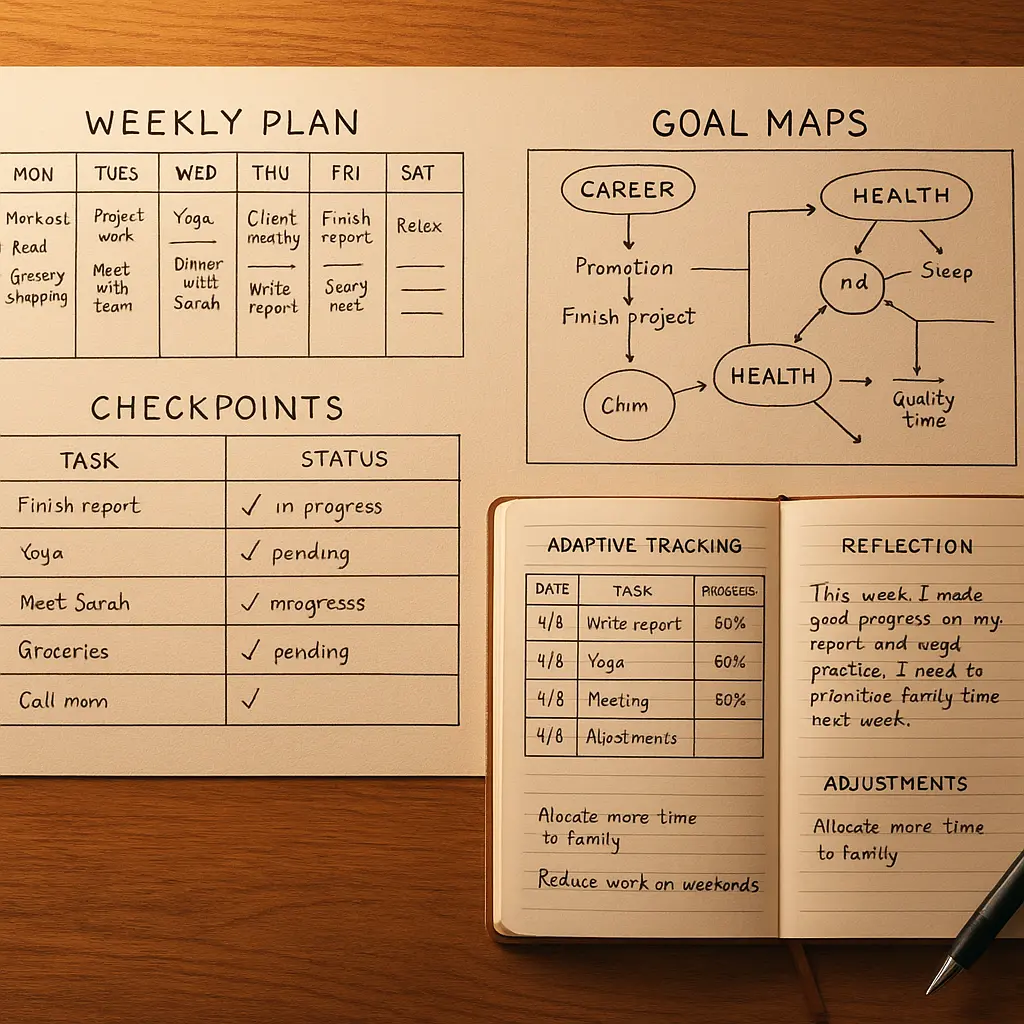
Kibo transforms personal goals into structured weekly commitments rather than isolated daily habits. This weekly planning horizon allows for strategic resource allocation across multiple life domains while maintaining day-to-day flexibility. If unexpected work demands consume Tuesday, you can adjust Wednesday and Thursday plans to stay on track for your weekly commitments.
The platform continuously tracks progress against stated outcomes, not just task completion. If your goal is improving your relationship and you’re completing all your planned date nights and conversation prompts but your relationship satisfaction scores aren’t improving, the system identifies the disconnect and helps you explore alternative approaches.
The adaptive intelligence learns your patterns over time. It identifies when you’re most likely to follow through, which types of commitments you consistently avoid, and what circumstances correlate with your best performance. This pattern recognition enables increasingly personalized recommendations that generic habit trackers cannot provide.
How AI Coaching Differs From Conversational AI
Platforms like Pi.ai offer empathetic conversation and emotional support but lack structured goal frameworks and systematic accountability. You can discuss your challenges and receive thoughtful responses, but there’s no systematic tracking of commitments, no progress measurement against defined outcomes, and no adaptive programming that adjusts your action plan based on results.
Effective AI coaching requires both the conversational intelligence to understand your situation and the systematic structure to transform insights into action, track follow-through, and measure results. The combination creates accountability that feels personalized while maintaining the consistency and structure that drives behavioral change.
Making the Transition From Tracking to Coaching
Moving from habit trackers to goal accountability systems requires a mindset shift from measuring activity to measuring outcomes. Start by defining specific, measurable results you want to achieve in the next 90 days across your priority life domains. Revenue targets, fitness metrics, relationship quality indicators, or skill development milestones work better than vague aspirations.
Next, work backward from those outcomes to identify the weekly commitments most likely to produce them. This is where AI coaching provides immediate value because it helps you distinguish between actions that feel productive and actions that actually drive progress. Many people discover they’ve been completing low-impact habits while avoiding high-impact behaviors that feel uncomfortable.
Finally, establish review rhythms where you examine not just whether you completed planned actions but whether those actions produced intended results. Weekly reviews allow rapid iteration and course correction that monthly or annual reviews cannot match. The data consistently shows that professionals who review progress weekly achieve goals faster than those who review monthly or quarterly.
Frequently Asked Questions
Can I use both a habit tracker and an AI coaching platform together?
You can, but it’s usually redundant and creates unnecessary complexity. AI coaching platforms include the tracking functionality you need while adding outcome measurement and adaptive programming that habit trackers lack. Running parallel systems splits your attention and makes it harder to see the integrated view of your progress across life domains. If you’re currently using a habit tracker, try replacing it completely with a coaching platform for 30 days to compare the experience and results.
How much does AI coaching cost compared to habit tracking apps?
Basic habit trackers range from free to $5-10 monthly for premium versions. AI coaching platforms typically cost $20-50 monthly, positioning them between basic trackers and human coaching at $200-500 monthly. The price difference reflects substantially more functionality including personalized goal-setting, adaptive programming, outcome tracking, and intelligent accountability. Most professionals find the additional investment worthwhile when it produces measurable progress toward important goals rather than just tracking activity.
What if I have simple goals that just need consistency?
If your objective genuinely involves pure repetition of a simple behavior with no need for adaptation, personalization, or outcome tracking, a basic habit tracker works fine. Examples include taking daily medication, drinking water, or maintaining existing fitness levels. However, most people underestimate the complexity of their goals. What seems like a simple consistency problem often involves strategic challenges, psychological barriers, or competing priorities that benefit from coaching-level support.
How quickly can I expect to see better results with AI coaching?
Most users report clearer goal clarity and better prioritization within the first week as the platform helps them distinguish between low-impact busy work and high-impact actions. Measurable outcome improvements typically appear within 4-6 weeks as you iterate on your approach based on weekly progress reviews. The adaptive intelligence becomes more valuable over time as it learns your patterns, so the gap between AI coaching and basic tracking widens the longer you use the system.
Will AI coaching work if I have trouble staying motivated?
Motivation problems usually stem from unclear goals, lack of visible progress, or pursuing objectives that don’t actually align with your values. AI coaching addresses all three by helping you clarify what you really want, connecting daily actions to measurable outcomes, and surfacing misalignments between your stated priorities and your behavior. The accountability feels more meaningful because it’s personalized to your situation rather than generic reminders. That said, AI coaching works best for people who genuinely want to change but struggle with structure and accountability, not for people who haven’t yet decided they want different outcomes.
Can AI coaching replace therapy or professional mental health support?
No. AI coaching platforms help you structure goals, track progress, and maintain accountability for behavioral changes. They don’t provide clinical mental health treatment, trauma processing, or therapy for conditions like depression, anxiety disorders, or other mental health challenges. If you’re experiencing mental health issues that affect your daily functioning, work with licensed mental health professionals. AI coaching can complement therapy by helping you implement behavioral recommendations from your therapist, but it’s not a substitute for clinical treatment.
What’s your biggest frustration with habit trackers you’ve tried, and what would make you switch to a different approach?
Leave a Reply